
Custom Injection Molding vs. 3D Printing: Which Wins in 2026?
Custom injection molding is the better choice for high-volume production parts in 2026, offering lower per-unit costs, superior strength, and tight tolerances once you scale past a few thousand units. 3D printing wins for rapid prototyping and very low-volume runs, where speed and minimal upfront tooling cost matter most. Many manufacturers, including Crestwood Industries, use both methods together to move a product from concept to completion.
Choosing how to make your production parts can shape your entire budget, timeline, and product quality. Two methods dominate the conversation: custom injection molding and 3D printing. Both have earned their place in modern manufacturing, yet they solve very different problems. Picking the wrong one can mean wasted money, missed deadlines, or parts that simply don’t hold up.
This guide breaks down how each method works, where each one shines, and which makes more sense for your project in 2026. You’ll find clear comparisons, real cost considerations, and practical advice drawn from decades of hands-on experience. By the end, you’ll know exactly which path fits your production goals, whether you’re making 500 parts or five million.
At Crestwood Industries, we run both processes under one roof in Illinois, so we see firsthand where each approach earns its keep. Let’s dig in.
How Does Custom Injection Molding Work?
Custom injection molding is a manufacturing method that shoots molten material into a mold cavity. The material fills the cavity, cools, and hardens into the final shape. Once the mold is built, the same part can be reproduced thousands or even millions of times with remarkable consistency.
Here’s the basic process step by step:
- Raw plastic pellets are fed into a heated barrel with a screw.
- The screw moves the material forward while the temperature climbs.
- The molten plastic collects into a measured volume called a shot.
- That shot is forced into the mold cavity at high pressure, often in less than one second.
- Circulating water cools the part, which then hardens and is ejected.
This high-pressure approach is exactly why injection molding can produce complex, intricate shapes that other methods struggle to match. The plastic presses tightly against every detail of the mold, capturing fine features with precision. You can learn more about the full process in our guide on how injection molding works.
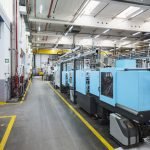
Among plastic injection molding manufacturers, the real value comes from scale. Crestwood Industries runs 22 presses ranging from 22 to 390 tons, producing parts in quantities from 500 to 5 million units, with tolerances as tight as 2 microns.
How Does 3D Printing Work?
3D printing, also called additive manufacturing, builds a part layer by layer from a digital model. Instead of forcing material into a mold, a printer deposits thermoplastic one thin layer at a time until the part is complete. There’s no tooling to build first, which is its biggest advantage for speed.
This makes 3D printing a favorite for prototyping, both for form and function. A part printed on a desktop 3D printer is usually ready overnight, and the design cycle of design, test, improve, and redesign moves much faster. Products that once took six to eight months to develop can now be ready in eight to ten weeks.
At Crestwood Industries, our 3D printing services focus on low-cost prototyping with very quick turnaround, often in less than 24 hours. It’s ideal for functional applications under non-critical loads, and a wide range of thermoplastic materials are available.
Custom Injection Molding vs. 3D Printing: A Side-by-Side Comparison
The clearest way to compare these methods is to look at them across the factors that matter most. The table below breaks down the key differences.
| Factor | Custom Injection Molding | 3D Printing |
| Best for volume | High volume (thousands to millions) | Low volume and prototypes |
| Upfront tooling cost | Higher (mold required) | Very low to none |
| Per-unit cost at scale | Very low | Stays high regardless of volume |
| Speed to first part | Slower (mold must be built) | Very fast (often under 24 hours) |
| Part strength | High, with compatible materials | Good, but layer lines can weaken parts |
| Tolerances | As tight as 2 microns | Looser, depends on printer |
| Material range | Broad engineering and commodity resins | Limited thermoplastics |
| Design changes | Costly once mold is made | Easy and inexpensive |
As the table shows, the two methods rarely compete head to head. They tend to serve different stages of a product’s life. A smart manufacturer often uses 3D printing early, then switches to injection molding for full production.
When Should You Choose Custom Injection Molding?
Custom injection molding makes the most sense once you need volume, durability, and repeatable precision. The upfront cost of building a mold pays off quickly when spread across thousands of parts.
Choose custom injection molding if these points describe your project:
- You need to produce hundreds to millions of identical parts.
- Tight tolerances and consistency are non-negotiable.
- The part must be strong and perform under real-world stress.
- You want the lowest possible cost per unit at scale.
- Your design calls for advanced features like over molding, insert molding, or multi-cavity tooling.
The strength factor deserves a closer look. Molded parts perform better because they’re made under high pressure with compatible materials, which adds real durability. For industries like medical, automotive, and military, that reliability isn’t optional. It’s the whole point.
Crestwood Industries works with engineering-grade resins such as polycarbonate, nylon, acrylic, acetal, and ABS, plus commodity resins like polypropylene and polystyrene. If you’re unsure which material fits your part, our team has decades of experience guiding that decision, and you can explore the best injection molding materials chosen by our experts.
When Should You Choose 3D Printing?
3D printing earns its place at the front of the design process. When you need to test an idea fast, it’s hard to beat.
Pick 3D printing if your situation looks like this:
- You’re still refining the design and need quick feedback.
- You only need a handful of parts, not a full production run.
- Speed matters more than per-unit cost.
- The part will handle non-critical loads.
- You want to validate form and function before investing in a mold.
Prototyping with 3D printing reduces financial risk. You can run functional tests on small quantities, catch problems early, and modify designs before committing to expensive tooling. That ability to fail cheaply and fix fast is what makes it so valuable in the early stages.
That said, 3D printing hits a wall at volume. Per-unit costs stay flat no matter how many parts you make, and the layer-by-layer build can leave weak points. Once you’re confident in your design and ready to scale, injection molding takes over.
Why Not Use Both? The Hybrid Approach
The smartest manufacturers don’t treat this as an either-or decision. They use 3D printing and injection molding together to get the best of both worlds.
Here’s how a typical project flows:
- Prototype with 3D printing. Validate the design, run functional tests, and gather feedback fast.
- Refine the design. Make changes cheaply before any mold exists.
- Build the mold. Once the design is locked, invest in tooling for production.
- Scale with injection molding. Produce thousands or millions of parts at a low cost per unit.
This combined workflow shortens time to market and lowers overall risk. It’s a big reason why injection molding remains the preferred method for mass production even as 3D printing grows. The two methods complement each other rather than compete.
Crestwood Industries supports this full journey, from concept to completion. You can prototype with our 3D printers, then move straight into production with our plastic injection molding services without switching vendors.
What About Cost? Breaking Down the Numbers
Cost is usually the deciding factor, so it’s worth understanding how each method spends your money differently.
3D printing carries little to no upfront cost. You skip the mold entirely, which is why it’s so affordable for one-off parts and prototypes. The catch is that each part costs roughly the same to make, whether it’s your first or your thousandth.
Injection molding flips that math. You pay more upfront to build the mold, but the per-unit cost drops sharply as volume rises. The table below shows how the break-even point typically works.
| Production volume | More cost-effective method |
| 1 to 50 parts | 3D printing |
| 50 to 500 parts | Depends on complexity and material |
| 500 to 5,000 parts | Often injection molding |
| 5,000+ parts | Injection molding |
There’s also good news on tooling cost. Molds don’t always require expensive hardened steel. Softer metals like aluminum can produce quality parts in quantities up to the thousands, which lowers the barrier to entry. A good custom plastic manufacturer will help you weigh these options and pick the right tooling for your budget and volume.
Which Method Is Better for Production Parts in 2026?
For true production parts, custom injection molding remains the better choice in 2026. The reasons are consistent year after year: lower cost at scale, stronger parts, tighter tolerances, and the ability to reproduce intricate details across millions of units.
3D printing keeps getting faster and cheaper, and it’s an excellent tool for prototyping and very small runs. But it hasn’t closed the gap on per-unit economics or part strength at volume. As our experts note, low volume injection molding remains king for producing affordable plastic parts, even with the rise of 3D printing.
The honest answer for most businesses is simple. Use 3D printing to perfect your design, then use injection molding to build it at scale. That pairing delivers speed early and savings later. For a deeper look at the advantages, see our breakdown of the key benefits of plastic injection molding.
Frequently Asked Questions
Is 3D printing cheaper than injection molding?
3D printing is cheaper for small quantities because it requires no mold. Once you pass roughly 500 parts, injection molding usually becomes cheaper per unit, since the mold cost spreads across a larger run. For high-volume production, injection molding is far more cost-effective.
How long does it take to get parts from injection molding?
Top-quality molded parts can often be completed in about 10 days once the mold is ready. Building the mold itself takes longer, which is why many companies prototype with 3D printing first. At Crestwood Industries, 3D-printed prototypes can be ready in under 24 hours.
Are injection molded parts stronger than 3D printed parts?
Yes, in most cases. Injection molded parts are formed under high pressure with compatible materials, which gives them greater strength and durability. 3D printed parts can show weakness along layer lines, making them better suited for prototypes and non-critical-load applications.
Can one company handle both 3D printing and injection molding?
Yes. Crestwood Industries offers both 3D printing and full in-house injection molding in Illinois. This lets you prototype and produce with a single partner, which shortens timelines and keeps quality consistent from concept to completion. You can contact our team to discuss your project.
Which method is best for medical or automotive parts?
Injection molding is generally the standard for medical and automotive parts because it meets strict tolerances and compliance requirements. Crestwood Industries is ISO 9001:2015 certified and FDA registered, with experience producing medical device components that demand precision and consistency.
Ready to Move From Concept to Completion?
The choice between custom injection molding and 3D printing comes down to where you are in your product’s life. Prototype with 3D printing to test fast and fix cheaply. Scale with injection molding to produce strong, precise parts at the lowest cost per unit. For most production parts in 2026, that combined approach wins every time.
Crestwood Industries can guide you through every step, from material selection to tooling to full-scale production, all made right here in the United States. Whether you’re launching a new product or reshoring an existing one, our team is ready to help. Collaborate with us or request a quote today, and let’s bring your idea to life.